
Internet blackouts occur when repressive governments instruct internet service providers to block or restrict access to the internet. Local laws require providers to comply with these orders so there are very few examples of internet companies successfully resisting them. Internet blackouts are becoming increasingly common: in 2024, governments imposed 296 internet shutdowns on 54 countries.
Governments can block access entirely or impose more selective restrictions: particular websites, platforms, or accounts; specific regions, communities, or even individuals.
Authorities do not always fully block content. They can also use throttling, where they deliberately slow connection speeds to the point that pages become effectively unusable. This approach is harder to detect, more subtle, and often allows governments to avoid scrutiny or accountability.
Living without the internet can isolate individuals, by restricting their access to news, interrupting their studies and impeding their ability to earn a living.
Why do oppressive regimes shut the internet down?
Authoritarian governments use internet shutdown powers to suppress political communication, control public narratives, and protect themselves. However, they often make up excuses such as preventing exam cheating or stopping the spread of misinformation.
The UN Human Rights Council consistently condemns internet shutdowns. Courts around the world have ruled the practice unconstitutional, including in India, Zimbabwe and Sudan. However, all three countries have continued to use internet shutdowns to punish their populations.
Internet shutdowns are often silent crimes. By cutting off communication, governments prevent their citizens from reporting abuses or organising resistance, which weakens international scrutiny over a national government.
The Iranian regime has a history of turning off the internet when unrest occurs. Just ten days after anti-government protests began on the 28th of December 2025, the Iranian authorities imposed a nationwide internet blackout. With connectivity cut during the protests, reliable information is extremely difficult to obtain, but at least 7,000 Iranians have been killed by the state, with some estimates reaching up to 30,000. The United Nations is now preparing to investigate potential crimes against humanity. After two weeks of internet blackout some connectivity was restored, however following US/Israeli strikes on Iran, the internet has been plunged back into darkness.
What’s happened in Iran since the war?
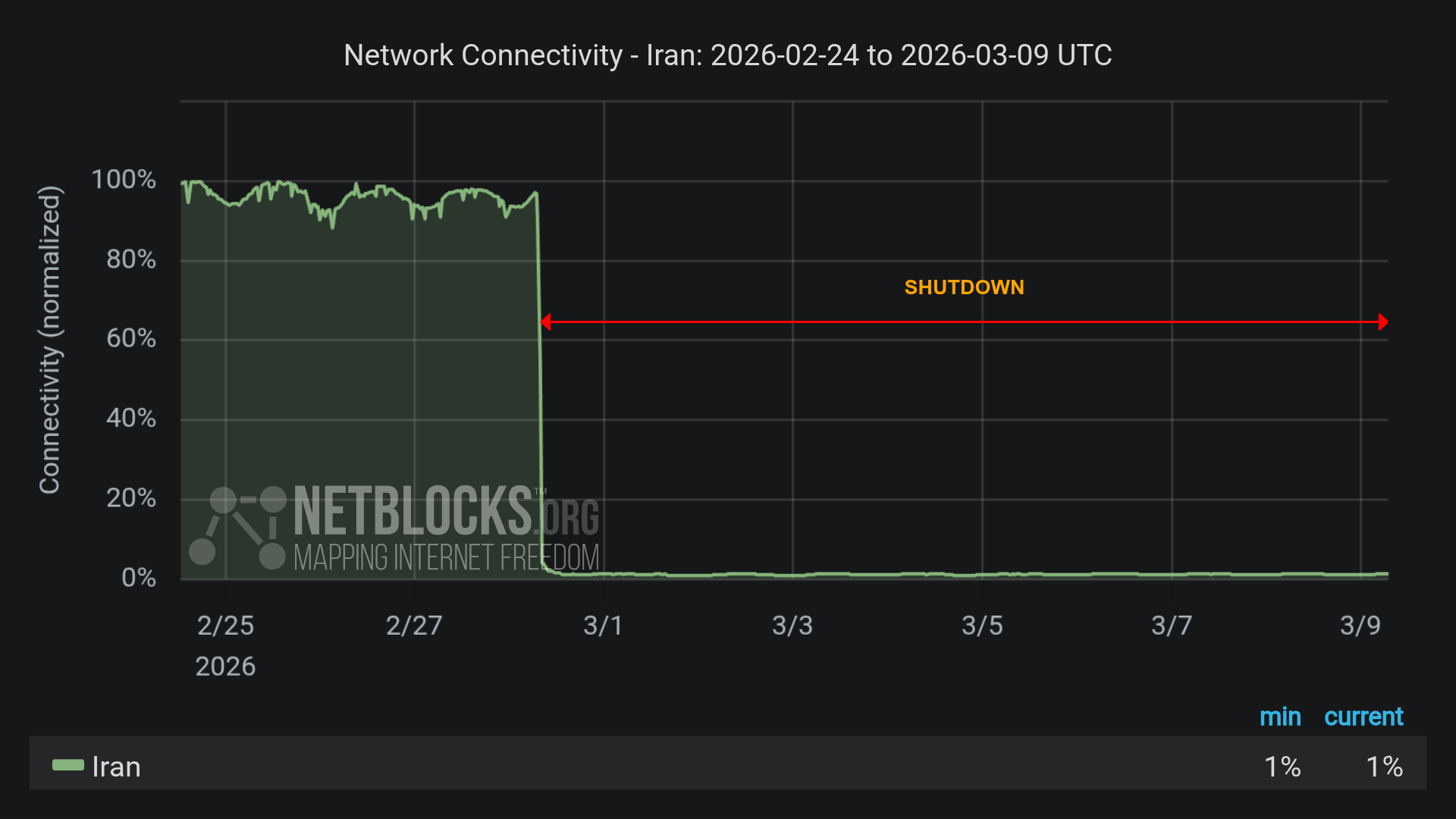
Image: netblocks.org
Now, in March 2026, the people of Iran are under attack from US and Israeli aggression. The regime has throttled the Iranian internet to just 1% capacity. Limited capacity makes it harder for the whole international community to witness the destruction wrought upon Iran.
Israeli intelligence reportedly hacked traffic cameras and monitored their feeds over years, learning the patterns of Iranian officials and using that data to track Ali Khamenei’s movements. On the day of the assassination, cellular networks were disrupted, preventing warnings from reaching his bodyguards.
This was not the work of a free and open internet. It was the result of surveillance, hacking, and deliberate signal blackouts. The very tools authoritarian governments such as Khamenei’s relied on when they shut down networks, monitor citizens, and control the flow of information.
As the Iranian regime clings onto power, the future of Iranians’ access to the internet is unsure.
What is life like under an internet blackout?
Governments typically choose to blackout the internet during periods of conflict, making citizens’ lives even more disoriented and endangered. Independent news, eyewitness accounts, and messages from loved ones disappear, replaced by whatever narrative those in power choose to broadcast.
Those inside or out of the country have no way of knowing if their friends and family are safe. People do not know which roads are secure, which areas are under attack, or what is happening beyond their immediate surroundings. In times of unrest, this lack of information can be deadly.
During periods of political violence, hospitals in Bangladesh refused to treat wounded protesters. Without the internet, people do not know which hospitals are safe or willing to provide care. Families are left guessing where to take sick people, often losing critical time.
An internet blackout also cuts workers off from their livelihoods. They cannot work remotely, apply for jobs, or access basic services. Economic survival becomes another casualty of the shutdown. In the first days of Iran’s internet blackout, even the state apparatus had lost connection: including the banks. The net effect was that Iranians were unable to access their own bank accounts and money. This made it hard for families to purchase food and receive money sent to them.
How do we get information out during a blackout?
Depending on the methods used to restrict internet connectivity, internet users can use a Virtual Private Network (VPN) to make their connection less likely to experience interruptions.
VPN services are available and commonly used by Iranians. However they typically only work until they become popular enough for the authorities to notice and block. When the Iranian regime first blocked the internet in response to the recent protests, not even VPNs worked. Slowly they have begun working again.
Satellite internet services like Starlink are another option for sidestepping an internet shutdown. Starlink’s low-orbit satellites offer connection almost anywhere in the world. As the infrastructure is not terrestrial it falls beyond the geographical pressure that governments can put on telecom providers and is therefore an alternative route to bypass shutdowns.
Starlink terminals smuggled into the country are allowing a few Iranians to share videos and images with the outside world. Iranian authorities are jamming starlink signals to prevent this communication - it is operating at 30% capacity.
However, we can’t rely purely on Starlink to protect us from authoritarians. It is a US corporation controlled by Elon Musk. Following Russia’s invasion of Ukraine he promised support, only to cut coverage when it was needed most.
Access does not equate to a free and fair internet. In the case of Iran, the internet is a place of surveillance, where every action can be scrutinised by intelligence agencies. Social media platforms are blocked; having an account can make you vulnerable to persecution. Phone calls are listened to and messages are intercepted. As a result, people are less likely to voice their criticisms of the Iranian regime.
Resistance
A free and fair internet is one of the most powerful checks on power a civilian population can have. It allows citizens to document and share evidence of human rights abuses, cutting through government denials and earning international attention. In recognition of this, several civil society organisations support access to information and the internet.
Globally, the KeepItOn coalition tracks internet shutdowns all over the world and builds international support for an open and available internet.
The Digital Rights Division of the MIAAN group supports civil society groups and marginalised communities learn digital hygiene. [Tech Tavaana](https://tech.tavaana.org/) offers informational resources on maintaining digital privacy whilst accessing a surveilled internet.
The Digital Rights Division also hosts the Iran After Dark Programme which helps Iranians prepare for internet shutdowns and communicate during disruptions.
The NetFreedom Pioneers offer Toosheh Data Casting technology. This technology allows information to hitch a ride on TV streams and be intercepted by off-the-shelf free to air satellite receivers.
DRW invites you to donate to these groups to support them in their missions.
Could Australia’s internet be shut off?
Under section 581 of the Telecommunications Act 1997 (Cth), the eSafety Commissioner may issue written directions to internet service providers requiring compliance with shutdown orders.
Amendments introduced in 2003 during the “War on Terror” expanded the Attorney-General’s powers, including the capacity to order the suspension of internet services either broadly or in relation to specific individuals. These amendments were enacted through an expedited process, attracting minimal public scrutiny and only two submissions, one from Vodafone and one from the NSW Council for Civil Liberties. Given the close regulatory relationship between major telecommunications providers such as NBN and Telstra and the Australian Government, there may be limited practical resistance if such powers were exercised.